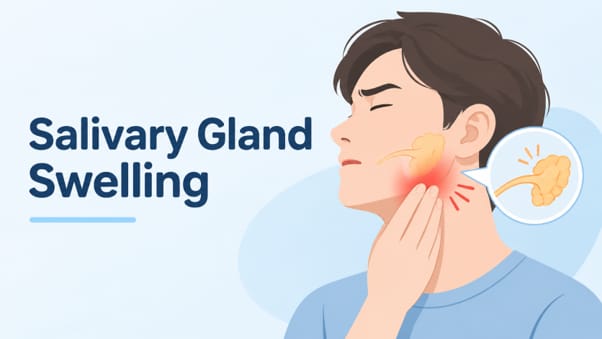
Introduction: Understanding Salivary Gland Swelling During Meals
Have you ever noticed swelling beneath your jaw or around your cheeks while eating? The swelling may feel uncomfortable or painful, particularly when chewing, before gradually settling after your meal.
This can happen when saliva cannot flow normally from the salivary glands into the mouth. Although salivary gland stones are a common reason for meal-related swelling, infections, inflammation, and narrowed saliva ducts may also be responsible.
Understanding why the swelling occurs can help you recognise when medical assessment may be necessary.
Why Do Salivary Glands Swell During Meals?
Salivary glands produce saliva, which helps moisten food, supports swallowing, and begins the digestion process. The main salivary glands are located beneath the jaw, under the tongue, and near the ears.
When you eat, your body naturally increases saliva production. The saliva travels through small tubes, called ducts, before entering your mouth.
However, if a duct becomes blocked or narrowed, saliva may struggle to flow freely. As more saliva is produced during meals, pressure can build up inside the affected gland, causing swelling or discomfort.
The swelling may become noticeable shortly before or during eating and gradually reduce afterwards.
This repeated pattern of swelling during meals can be an important clue that something is affecting normal saliva drainage.
What Causes Salivary Gland Swelling During Meals?
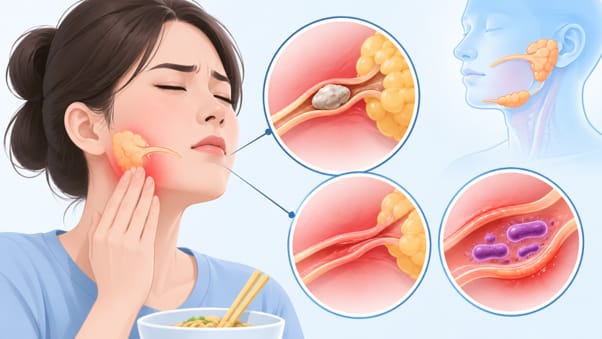
Several conditions can affect saliva production or drainage. The following are some possible causes of swelling that develops or becomes more noticeable when eating.
1. Salivary Gland Stones
Sialolithiasis (Salivary gland stones), are hardened mineral deposits that develop inside a salivary gland or its drainage duct.
These stones can partially or completely block the movement of saliva into the mouth.
When saliva production increases during meals, the blockage may cause pressure to build up behind the stone, resulting in pain and swelling.
Salivary gland stones most commonly affect the glands beneath the lower jaw, although they can occur in other salivary glands.
Some people experience repeated episodes of swelling that settle after eating. Others may develop more persistent discomfort if the blockage remains.
The exact reason stones form is not always clear. Reduced saliva flow and dehydration may contribute in some cases.
2. Narrowing of the Salivary Duct
Salivary gland swelling can also develop when a saliva duct becomes unusually narrow. This narrowing may result from previous inflammation, scarring, or other changes affecting the duct.
Even without a stone, a narrowed duct may restrict saliva drainage, particularly when the glands produce more saliva during meals.
The symptoms can resemble those caused by salivary stones, including recurring swelling, pressure, and discomfort around the affected gland.
3. Salivary Gland Infection or Inflammation
Salivary glands can become inflamed or infected, sometimes because saliva is not draining properly.
When saliva remains trapped, bacteria may multiply and contribute to an infection.
An affected gland may become swollen, tender, and painful. Some people also develop fever, redness, or an unpleasant taste caused by discharge into the mouth.
However, not all salivary gland infections are caused by bacteria. Identifying the underlying cause is important because antibiotics are not necessary for every case.
4. Other Salivary Gland Conditions
Less commonly, salivary gland swelling may be associated with conditions affecting saliva production or gland tissue.
For example, Sjögren’s syndrome is an autoimmune condition that can cause dry mouth and swelling of the salivary glands.
Growths within a salivary gland may also cause swelling or a persistent lump, although these are less likely to produce the typical pattern of swelling that repeatedly appears during meals.
A medical examination helps distinguish these conditions from a blocked salivary duct.
What Symptoms May Accompany Salivary Gland Swelling?
The symptoms of salivary gland swelling depend on which gland is affected and the underlying cause.
Common signs include:
- Swelling beneath the jaw or near the ears: The affected gland may become visibly enlarged during meals.
- Pain or pressure when eating: Discomfort may increase as saliva production rises.
- Repeated swelling: The gland may swell during meals and gradually return to its usual size afterwards.
- Tenderness: The swollen area may feel sensitive when touched.
- Dry mouth: Reduced saliva flow may leave the mouth feeling unusually dry.
- Unpleasant taste or discharge: This may occur when an infection affects the gland.
Some people experience swelling without significant pain, particularly when the blockage is incomplete.
The absence of pain does not necessarily mean that no underlying problem exists.
When Should You Seek Medical Attention for Salivary Gland Swelling?

Occasional mild discomfort may settle without intervention. However, swelling that repeatedly develops during meals deserves medical attention, particularly if it becomes more frequent.
Consider arranging a medical assessment if:
- Swelling repeatedly occurs when eating.
- Pain becomes increasingly uncomfortable.
- The swelling does not disappear after meals.
- A persistent lump develops beneath the jaw or near the ear.
- You experience fever, increasing redness, or tenderness.
- Pus or an unpleasant discharge appears inside the mouth.
- Swelling begins to interfere with eating or swallowing.
A GP can provide an initial assessment and recommend specialist evaluation when needed.
Seek urgent medical attention if swelling rapidly worsens, particularly when accompanied by significant difficulty swallowing, breathing difficulties, or severe symptoms of infection.
Early assessment may help identify an obstruction or infection before further complications develop.
How Is Salivary Gland Swelling Diagnosed?
Diagnosing salivary gland swelling usually begins with understanding the symptoms and examining the affected area.
Medical History and Physical Examination
A doctor may ask when the swelling occurs, whether it is associated with meals, and how long it usually lasts.
The examination may involve checking beneath the jaw, around the cheeks and inside the mouth for swelling, tenderness or visible stones.
The doctor may also look for signs of infection or reduced saliva flow.
Imaging and Further Investigations
Additional investigations may be recommended when the cause is unclear. An ultrasound scan can help identify certain stones, gland swelling, or other abnormalities.
A CT scan may be useful when more detailed images are needed, particularly if a stone is difficult to locate.
In selected cases, a procedure called sialendoscopy may be considered. This involves passing a very small camera through the salivary duct to examine its interior and, in some cases, treat a blockage.
Not everyone requires imaging or specialist procedures. The investigations depend on the examination findings and suspected cause.
How Is Salivary Gland Swelling During Meals Treated?
Treatment depends on whether the swelling is caused by a stone, narrowed duct, infection, or another salivary gland condition.
Conservative Treatment for Mild Symptoms
For selected mild cases, a doctor may recommend measures that support saliva flow and relieve discomfort.
These may include:
- Drinking sufficient water throughout the day.
- Applying a warm compress to the affected area.
- Gently massaging the gland when medically appropriate.
- Using suitable saliva-stimulating methods when recommended.
These measures may relieve some symptoms, but they cannot reliably remove every blockage.
Avoid attempting to remove a suspected stone using sharp objects, as this can injure the mouth or cause infection.
Treating Salivary Gland Infections
If a bacterial infection is diagnosed or strongly suspected, antibiotics may be prescribed. Pain relief and supportive care may also help manage discomfort.
When an infection develops because of an underlying blockage, addressing the obstruction may be necessary to reduce recurring problems.
Removing Salivary Stones or Treating Blocked Ducts
Stones located near the opening of a salivary duct may sometimes be removed through the mouth.
For certain stones or narrowed ducts, sialendoscopy may allow the doctor to examine and treat the affected area using small instruments.
Larger or deeply positioned stones may require other procedures or surgery. The most suitable treatment depends on the stone’s size, location, the affected gland, and the patient’s overall condition.
Can Salivary Gland Swelling During Meals Be Prevented?
Not every salivary gland problem can be prevented, particularly when the cause involves stones or structural changes within the ducts.
However, several everyday habits may support healthy saliva production.
- Staying adequately hydrated is important, especially in Singapore’s warm and humid climate, where fluid loss through sweating can be greater.
- Maintaining good oral hygiene may also help reduce problems associated with bacteria in the mouth.
- If you experience persistent dry mouth, discuss it with a healthcare professional. Certain medications and medical conditions can reduce saliva production.
- Repeated swelling during meals should still be assessed rather than managed through preventive measures alone.
Conclusion: Understanding Salivary Gland Swelling During Meals
Salivary gland swelling that develops during meals is often associated with restricted saliva drainage. Stones and narrowed ducts are important possible causes, although infections and other gland conditions may produce similar symptoms.
While some mild episodes may settle naturally, repeated swelling, persistent pain, or signs of infection should not be overlooked.
If symptoms continue, consulting an ENT specialist may help determine the underlying cause and whether further investigations or treatment are necessary.
Understanding the reason for the swelling is the first step towards managing the condition appropriately.
Frequently Asked Questions
1. Why does my jaw swell when I eat?
Swelling may occur when a salivary duct becomes blocked or narrowed. Increased saliva production during meals can create pressure inside the affected gland.
2. Can salivary gland swelling go away on its own?
Some mild episodes settle naturally, and small stones may occasionally pass without treatment. However, recurring swelling may indicate an unresolved blockage that requires assessment.
3. Are salivary gland stones dangerous?
Salivary gland stones are usually not serious, but persistent blockages can cause recurring pain, swelling, or infection. Treatment may be necessary when symptoms continue.
4. Does salivary gland swelling always mean an infection?
No. Stones, narrowed ducts, and non-infectious inflammation can also cause swelling. A medical examination helps determine whether an infection is present.
5. Can salivary gland swelling affect only one side of the face?
Yes. When a single salivary gland or duct is affected, swelling may develop on only one side of the jaw or cheek.